Trumpet Microphones
Since I’ve been doing more and more stage work which requires a microphone I’ve been thinking about investing in a decent wireless trumpet microphone. However this brings up a whole load of other questions; what type of mic should I be looking at? Is it worth the price they are currently going for (pound Vs dollar) and does it bring enough of an advantage over a stand mic to make it worth buying at all?
Hopefully by writing this and my follow up post I’ll be able to answer these questions myself. I think I’ve come to a conclusion with my first question; what type of mic should should I be looking at?
Bell Clip Mic Vs Any Other Mic
I’m not a fan of the bell clip mic. I know a few people who have said that they have scratched and damaged their instruments using them. I have to say from my own experience I’ve never suffered damage from bell clips but the it’s the sound and tone quality that has never been great and puts me off.
I suspect that’s because the trumpet sound doesn’t centre itself the instant that it leaves the bell. My Calicchio in particular hits its sweet-spot about 30 cm away from the bell.
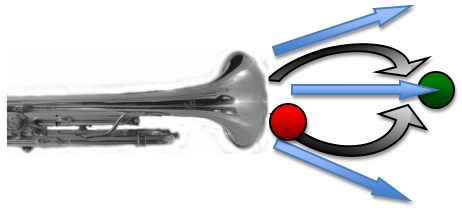
The Red Circle indicates the area that bell clip would pick up whereas the green is where a mic stand can potentially pick up for the best sound. So ideally we’d be looking for a mic that gives you the freedom to move as the bell clip does yet has it’s placement further from the bell to receive a better sound.
Enter the specialized trumpet microphones.
Specialized Mic Vs Stand Mic
The great thing about the specialized trumpet microphones are that they’re specific design for the instrument. You obviously gain the freedom of movement, not having to worry about your mic placement ever few minutes, whilst having the mic closer to the horns sweet-spot. This gives a better and more accurate representation of your true sound. It also looks very cool.
But there are certain things that the mic can’t do. Not all because of design flaws but by the very nature of the mic itself.
It’s not the most popular thing to do but you’d be a liar to say that if you didn’t want to give certain parts of a chart that extra kick you’d move onto your mic a little more. I’m sorry sound engineers, I only do it a little bit. You can’t do this simply due to the nature of any kind of attached mic.
There’s also the big issues of valve sound and the increasing the potential for problems. The valve sound comes from the mic being attached to the trumpets frame. Any clicks from the valve will vibrate straight into the mic along with any other unwanted sounds. There’s also the problem that adding wireless technology into the mix could also end in disaster. It only takes a bad sound engineer, a flat battery or standing in just the wrong place to cause some serious problems in a gig.
So here is my big question. Is the specialized mic better than a stand mic? If so, does it bring enough to be worth the investment? My Solution?
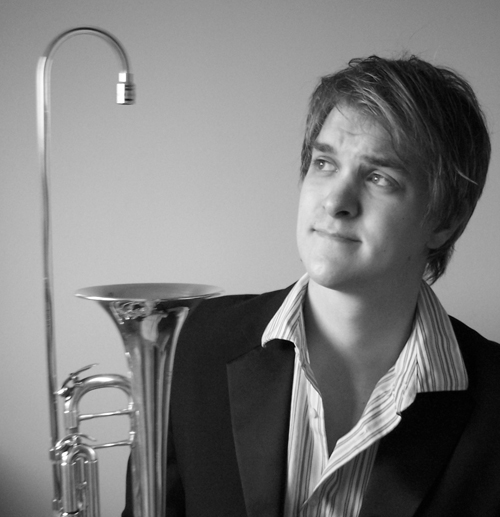
The only way I can find out is to try. So I’ve managed to borrow one from a fellow pro which I’ll be testing out on my next Shades gig. It’s the only real way to find out if it works for me without spending a small fortune first. I’ll post my findings and more details on the mic itself after the gig in a few weeks.
That mic looks strangely familiar to me… I’m sure I had one of those around here somewhere…
H-hem, er… no, no.. I think you’re mistaken, it just looks a lot like your mic. You know, the one that you lost… ? … 🙂
By the look of it I think it must have vibrated it’s way down to London. Did you flick it just before you took the picture or is it alive?
I suspect it’s the valve vibration!
Anything to stop you wandering off mic can only be a good thing mate
Woa woa woa!!!
That only happened once 😀 and it seemed like a good idea for the brass section to make a break for the other platforms . . . at the time….
I like to keep you on your toes.
*Andy T is the sound engineer from the Emirates Palace gig in Abu Dhabi on New Years Eve. He’s one best sound engineers I’ve worked with – after a 2 hour rehearsal and 4 hour gig I still had my chops. Which as any brass player knows (particularly trumpeters) is because we can actually hear ourselves and are able to balance with the band properly. Yet he’s a git for giving me the most rubbish jobs when we were packing down!!
Plus it’s worth mentioning that in my last solo I managed to hit the Reds!!! 😛
Just stumbled upon this when Googling about trumpet mics…. have you managed to find your ideal trumpet mic yet? I’m on the hunt for one!